Beyond the Code: What's Really Blocking Your Next Promotion
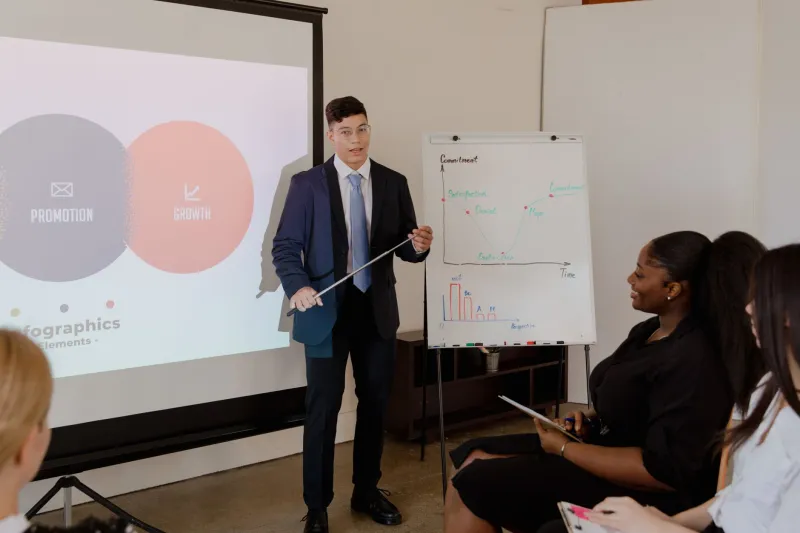
You've earned the certifications. You've mastered the tools. You consistently deliver results that outpace your peers. So why, when the promotion cycle comes around, does your name keep getting passed over?
This is one of the most frustrating—and surprisingly common—career plateaus in the American workforce. According to a 2023 LinkedIn Workplace Learning Report, 89% of hiring managers say that when a promotion falls through, the reason is almost never a lack of technical ability. The real culprit? A set of competencies that most professionals never formally develop because no one ever told them they needed to.
At ICS StepUp, we work with ambitious professionals every day who are grappling with exactly this disconnect. What we've found—backed by conversations with HR directors, talent strategists, and executive coaches across the country—is that the divide between a high performer and a promoted leader is rarely measured in lines of code or completed projects. It's measured in something far harder to quantify.
The Illusion of Meritocracy
Most professionals operate under a fundamental assumption: if you work hard enough and perform well enough, advancement will follow. It's a belief deeply embedded in American professional culture, and it's not entirely wrong. Performance absolutely matters. But it's only one dimension of how organizations evaluate leadership potential.
Career coach Renata Simmons, who has advised professionals at Fortune 500 companies including firms in healthcare, finance, and technology, puts it bluntly: "The moment you're being considered for a leadership role, the conversation shifts entirely. It's no longer 'Can this person do the work?' It's 'Can this person lead others through the work?' Those are two completely different questions."
This shift catches many high performers off guard because no one explicitly communicates it. You're evaluated on one set of criteria for years—output, accuracy, speed, technical skill—and then suddenly, invisibly, the goalposts move.
Emotional Intelligence: The Competency Organizations Actually Promote
Of all the soft skills that influence promotion decisions, emotional intelligence (EQ) consistently ranks at the top of what HR directors say they're looking for. EQ encompasses self-awareness, empathy, social regulation, and the ability to read interpersonal dynamics accurately.
Marcus Devereaux, a Director of Talent Acquisition at a mid-sized technology firm in Austin, Texas, describes it this way: "I can train someone on a new platform in three months. I cannot train them to handle conflict constructively, to read a room before a critical presentation, or to motivate a team through uncertainty. When I'm looking at promotion candidates, I'm looking for evidence that they can do those things without being told."
The challenge is that EQ is notoriously difficult to self-assess. Research from organizational psychologist Tasha Eurich suggests that while 95% of people believe they are self-aware, only about 10 to 15% actually meet the criteria for genuine self-awareness. This gap means that many professionals who believe they're emotionally intelligent are operating on incomplete data about how they're perceived.
Developing EQ requires intentional effort: seeking candid feedback, practicing active listening, and learning to pause before reacting in high-stakes situations. These are learnable skills—but they require structured development, not just good intentions.
Cross-Functional Collaboration: Speaking Every Department's Language
Another competency that separates promotable professionals from technical experts is the ability to collaborate effectively across functions. In most organizations, departments operate with distinct priorities, vocabularies, and success metrics. A marketing team defines success differently than an engineering team, which operates differently than a finance division.
Leaders are expected to bridge those worlds. They need to translate technical concepts into business value for executives, communicate constraints to stakeholders without causing alarm, and build coalitions across teams that may have competing interests.
For many technical professionals, this feels unnatural—even uncomfortable. "I spent years being rewarded for going deep," shared one senior software engineer we spoke with during a career coaching session at ICS StepUp. "Then I realized that the people getting promoted were the ones who could go wide—who could talk to the CFO just as comfortably as they could talk to a junior developer."
Building cross-functional fluency means proactively seeking exposure beyond your immediate team. Volunteering for interdepartmental projects, attending cross-functional meetings even when not required, and making a deliberate effort to understand how your work connects to broader organizational goals are all practical starting points.
Executive Presence: The Most Misunderstood Leadership Quality
Few terms in professional development are as frequently cited—and as poorly understood—as executive presence. It's often reduced to superficial attributes like confident body language or a polished wardrobe. In reality, executive presence is far more substantive.
According to research from the Center for Talent Innovation, executive presence accounts for 26% of what it takes to get promoted into senior leadership. It encompasses three core elements: gravitas (how you carry yourself and project confidence), communication (how clearly and compellingly you convey ideas), and appearance (the degree to which you signal that you belong in the room).
Gravitas, the most heavily weighted component, includes qualities like decisiveness, the ability to inspire confidence during a crisis, and the willingness to speak with authority even in ambiguous situations. These are not personality traits you either have or don't. They are behaviors that can be practiced, refined, and strengthened over time.
HR consultant Diane Park, who advises mid-market companies on talent strategy across the Midwest, notes that executive presence often comes down to how professionals behave when things go wrong. "Anyone can look polished during a successful product launch. The question is: how do you show up when the project is behind schedule and the client is frustrated? That's where leadership presence becomes visible—or absent."
The Step-Up Imperative: Developing What Credentials Can't Teach
The good news is that none of these competencies are fixed. Emotional intelligence can be cultivated. Cross-functional fluency can be built through deliberate exposure. Executive presence can be developed through coaching, feedback, and consistent practice.
What it requires is a willingness to invest in yourself as seriously as you've invested in your technical expertise. Most professionals spend thousands of hours and dollars on domain-specific certifications and tools. Far fewer invest equivalent energy in the leadership competencies that actually determine whether those technical skills translate into career advancement.
At ICS StepUp, our career coaching and professional development programs are specifically designed to address this gap. We work with professionals to identify their unique growth edges—whether that's strengthening their communication under pressure, building influence across organizational silos, or developing the kind of presence that signals readiness for senior responsibility.
The professionals who advance aren't necessarily the most technically gifted people in the room. They're the ones who recognized early that technical mastery is the entry ticket—not the winning hand. They stepped up, invested in the full picture of professional capability, and made themselves undeniable.
Your credentials got you in the door. The question now is: what will carry you to the next floor?
Ready to identify and close your own skills gap? Explore ICS StepUp's career coaching and leadership development programs at icstepup.com.